


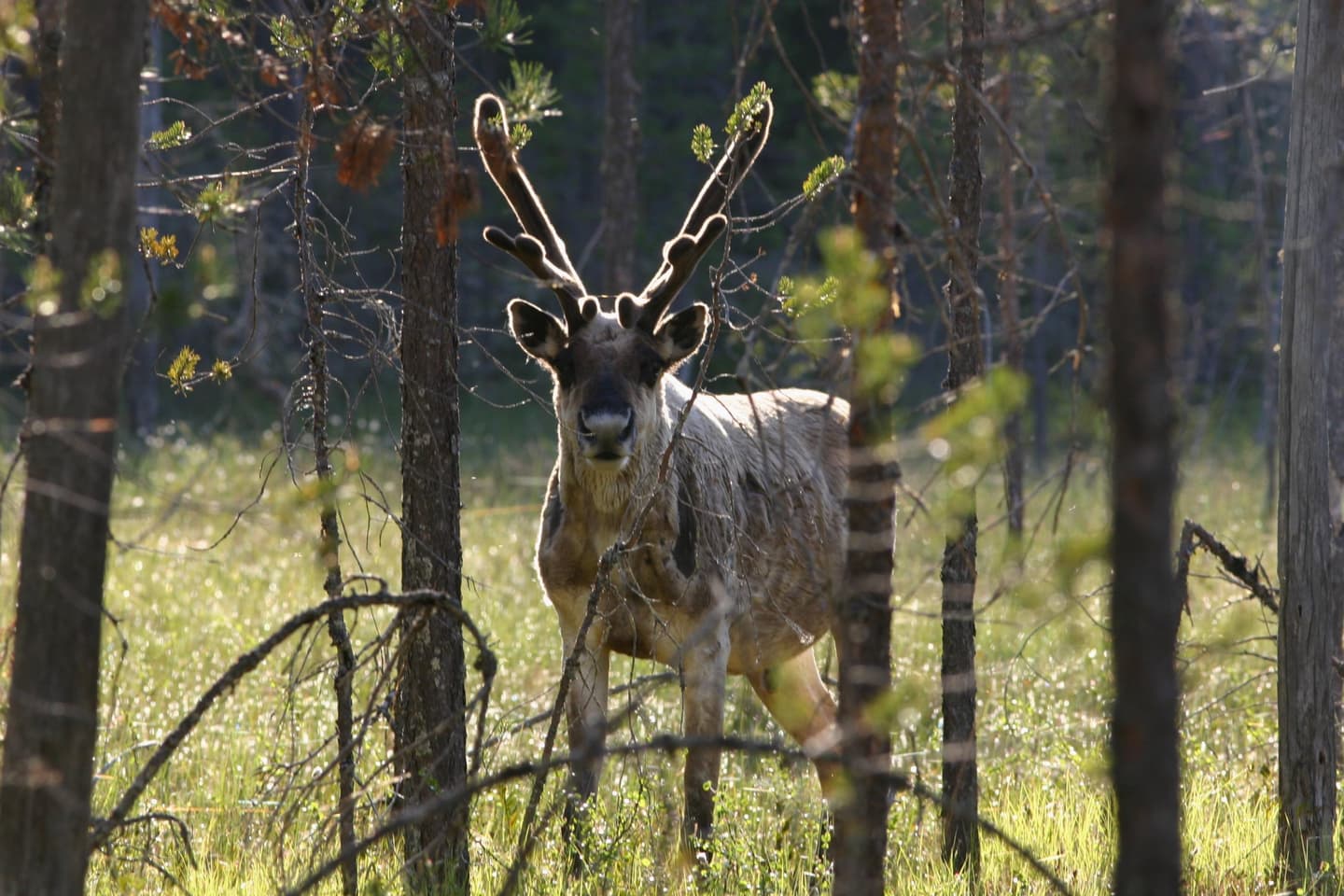
These were precisely the key reasons for establishing Friendship Park in 1990: the aim was to protect the forest and mire wilderness areas of Kainuu, its lakes and eskers, as well as the habitats of the wild forest reindeer (Rangifer tarandus fennicus). Another important reason for establishing Friendship Park was to promote scientific research on nature.
To protect the habitat of the wild forest reindeer as extensively as possible, five separate nature reserves were brought together to form Friendship Park:
- Elimyssalo – wilderness forests at their finest
- Lentua – blue reflections
- Iso-Palonen–Maariansärkät – rolling eskers and sparkling waters
- Juortanansalo–Lapinsuo – landscapes of mires
- Ulvinsalo Strict Nature Reserve – access by permit only!
Together with their extension areas, they cover a total area of approximately 29,000 hectares.
Activities in Friendship Park are regulated by the rules and regulations.
Friendship Nature Reserve
At the same time as Friendship Park was established, the Finnish-Russian Friendship Nature Reserve was also created. It comprises Friendship Park and the 49,200-hectare Kostomuksha Strict Nature Reserve (Zapovednik Kostomukshkij) in Russian Karelia.
The establishment of the Friendship Nature Reserve originated from wild forest reindeer crossing from the Soviet Union into Elimyssalo in Kuhmo. The peaceful, unlogged wilderness of Elimyssalo provided suitable grazing and calving grounds. Gradually, the wild forest reindeer population became established, and Finland regained a large mammal that had been absent for decades. The spread of the wild forest reindeer across the national border into Finland inspired the idea of joint Finnish-Russian research and monitoring of nature conservation.
The agreement between Finland and the Soviet Union on the Friendship Nature Reserve was signed in October 1989. It was signed by Mikhail Gorbachev, Chairman of the Supreme Soviet of the Soviet Union and General Secretary of the Central Committee of the Communist Party of the Soviet Union, and Mauno Koivisto, President of the Republic of Finland. The agreement entered into force in summer 1990, when the Act and Decree concerning Friendship Park were enacted.
The Friendship Nature Reserve was the first pair of protected areas operating across the Finnish-Russian border. Through cooperation, the valuable natural environment of the border region was managed and studied, while also providing information, experiences and opportunities for outdoor recreation. The shared nature reserve promoted mutual understanding between people and fostered cooperation in nature conservation.
Finnish-Russian cooperation ended in February 2022 due to Russia’s war of aggression.
Hiking, berry picking, hunting and learning
On the Finnish side, the areas of Friendship Park, with the exception of Ulvinsalo Strict Nature Reserve, are suitable for hiking, guided nature activities and nature tourism. The areas offer nature enthusiasts marked trails and maintained facilities, as well as wild, unspoilt wilderness for independent exploration.
On the Russian side, access to Kostomuksha Strict Nature Reserve is restricted, but visitors can explore the reserve on guided excursions along its nature trails.
Elimyssalo
Elimyssalo is one of the largest nature reserves in Kainuu. It covers a total area of 7,300 hectares (9,200 hectares including the extension areas). The landscape is typical of the Kainuu wilderness: large and varied mires, spruce-dominated herb-rich forests draped in beard lichens, pine forests gradually giving way to spruce, lush stream banks, and small lakes and ponds.
Elimyssalo is known as the area where wild forest reindeer first settled after returning to Finland. All four of Finland’s large carnivores, the brown bear, wolf, lynx and wolverine, also roam the area. Old-growth forest species are well represented among the birds, as 90% of the forests are more than 120 years old.
Elimyssalo’s two old wilderness homesteads, Levävaara and Latvavaara, offer visitors a glimpse into life in the remote forested hills of bygone days. Today, people come to Elimyssalo to enjoy wilderness activities, pick berries, hike and photograph nature.
- Read more about Elimyssalo Nature reserve
Lentua – Blue Reflections
Lentua is a peaceful lake with a true wilderness feel. It is the largest unregulated lake in the Oulujoki river system. Water covers 75% of the protected area (6,740 ha), while the rest consists of islands and shoreline areas. Lentua is an important habitat for the wild forest reindeer, which can be seen in the area both in summer and winter. With its valuable fish stocks, Lentua also provides feeding and nesting sites for both forest and water birds.
Lentuankoski, the largest rapid in Kuhmo, flows out of Lake Lentua and is a popular attraction and fishing destination. Lake Lentua itself attracts visitors and local residents for boating and canoeing, while in winter its glistening snow-covered expanses invite visitors to go cross-country skiing.
- Read more about Lentua Nature reserve
Iso-Palonen–Maariansärkät – rolling eskers and sparkling waters
The Iso-Palonen–Maariansärkät area (4,031 ha) encompasses the headwater lakes of the Kalliojoki waterway, along with the isthmuses and esker formations between them. The eskers have been important migration routes and summer grazing grounds for wild forest reindeer.
A scenic hiking trail also runs along the eskers. The waterways, in turn, offer excellent opportunities for canoeing and kayaking. From Iso-Palonen, you can paddle to Lentua and continue towards Lake Oulujärvi.
- Read more about Iso-Palonen - Maariansärkät Nature reserve
Juortanansalo–Lapinsuo – mire landscapes
More than half of the Juortanansalo–Lapinsuo area (5,100 ha) consists of mires. The forested islands within the mires are home to old spruce forests. In places, the vegetation along streams is lush, with patches of herb-rich forest. Despite selective logging in the past, the forests remain close to their natural state.
Juortanansalo–Lapinsuo is a wilderness area for independent hikers with good wilderness skills. Visitor services are limited.
- Read more bout Juortanansalo-Lapinsuo
Ulvinsalo Strict Nature Reserve – access by permit only!
The landscape of Ulvinsalo Strict Nature Reserve (2,500 ha; 3,934 ha including the extension areas) is characterised by steep-sided forested hills interspersed with small mires. The forests are extremely old, pristine old-growth forests. The waterways consist of small mire ponds and headwater streams.
Ulvinsalo Strict Nature Reserve was established as early as 1956. Strict nature reserves have been established primarily for nature conservation and scientific research. The aim is to keep nature in these areas as undisturbed as possible. Therefore, the rules and restrictions concerning access are considerably stricter than in other protected areas. Some strict nature reserves have marked hiking trails, but all access to Ulvinsalo Strict Nature Reserve requires a permit from Metsähallitus. Read more about strict nature reserves.
Kostomuksha Strict Nature Reserve – wilderness of old-growth forests
Kostomuksha State Nature Reserve (Zapovednik Kostomukshkij) was established on 14 December 1983 to protect boreal forests and the wild forest reindeer. The area is characterised by rugged upland landscapes, where rocky outcrops, mires and waterways alternate with old-growth forests stretching as far as the eye can see. The average age of the forests is approximately 170 years, but individual trees more than 340 years old can also be found in the reserve. The most significant bodies of water are Lake Kivijärvi, also known as Lake Kiitehenjärvi, and the River Kivijoki, which flows from the lake.
The reserve is primarily dedicated to nature conservation and scientific research, but environmental education and nature tourism have also been developed.
Under Russian nature conservation legislation, Kostomuksha Strict Nature Reserve is a “strictly protected area”, where hunting and fishing as well as picking mushrooms and berries are prohibited. Visitors may only travel along marked routes and must be accompanied by a reserve guide. A separate permit is also required to visit the reserve and can be obtained from the reserve office.
The local nature trail in the town of Kostomuksha, however, is easily accessible.
Research activities
Nature conservation research and ecosystem monitoring are carried out in Friendship Park. The research activities are coordinated by the Finnish Environment Institute.