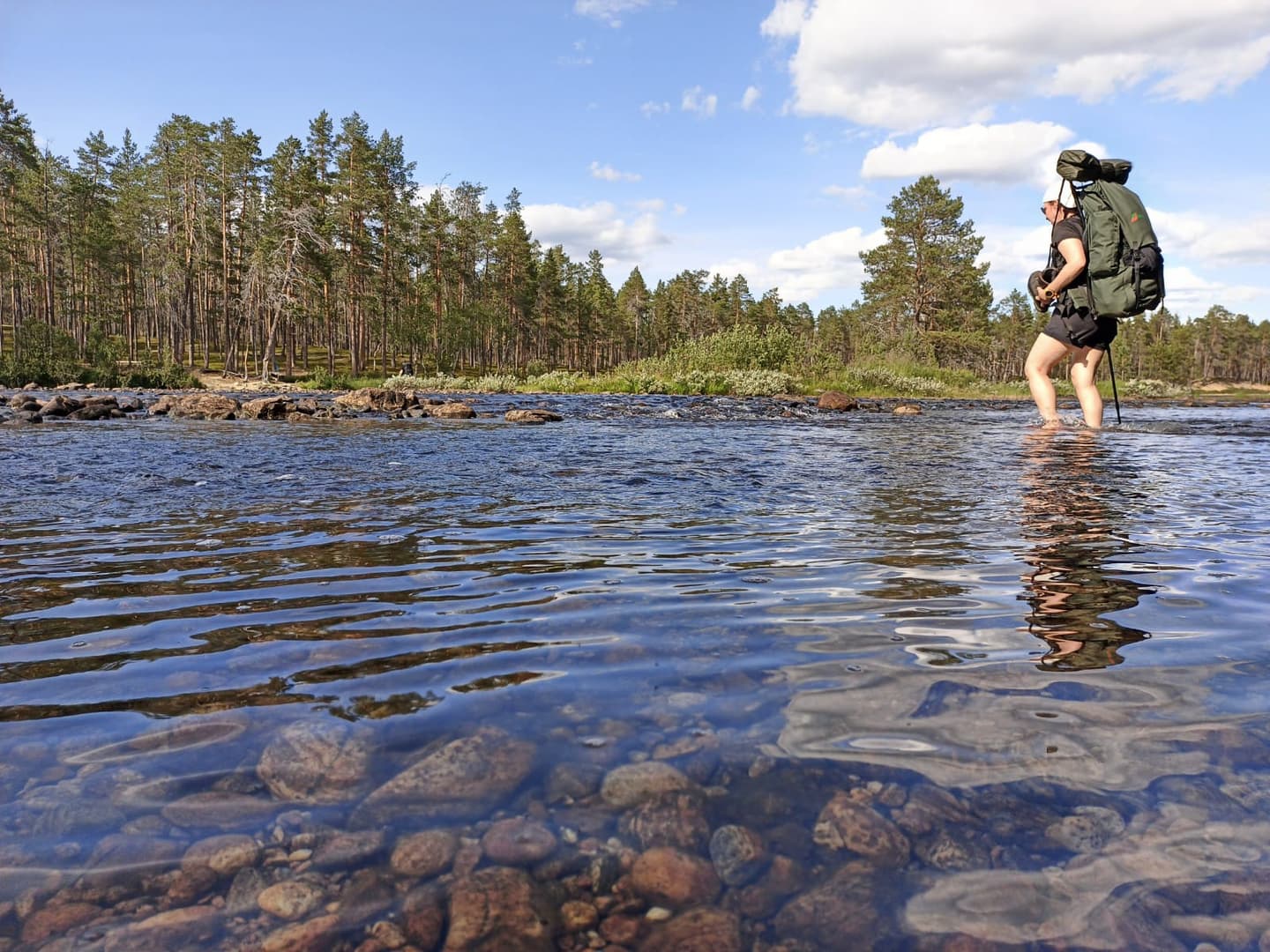
When planning a hike, maps provide advance information about the types of watercourses you may encounter and the available crossing points. Crossing points may include bridges, fords, cable ferries, and sometimes even boat transport services. Crossing watercourses always involves risks, which should be taken into account. You can prepare by packing your gear – or at least spare clothing and electronic devices – in waterproof bags.
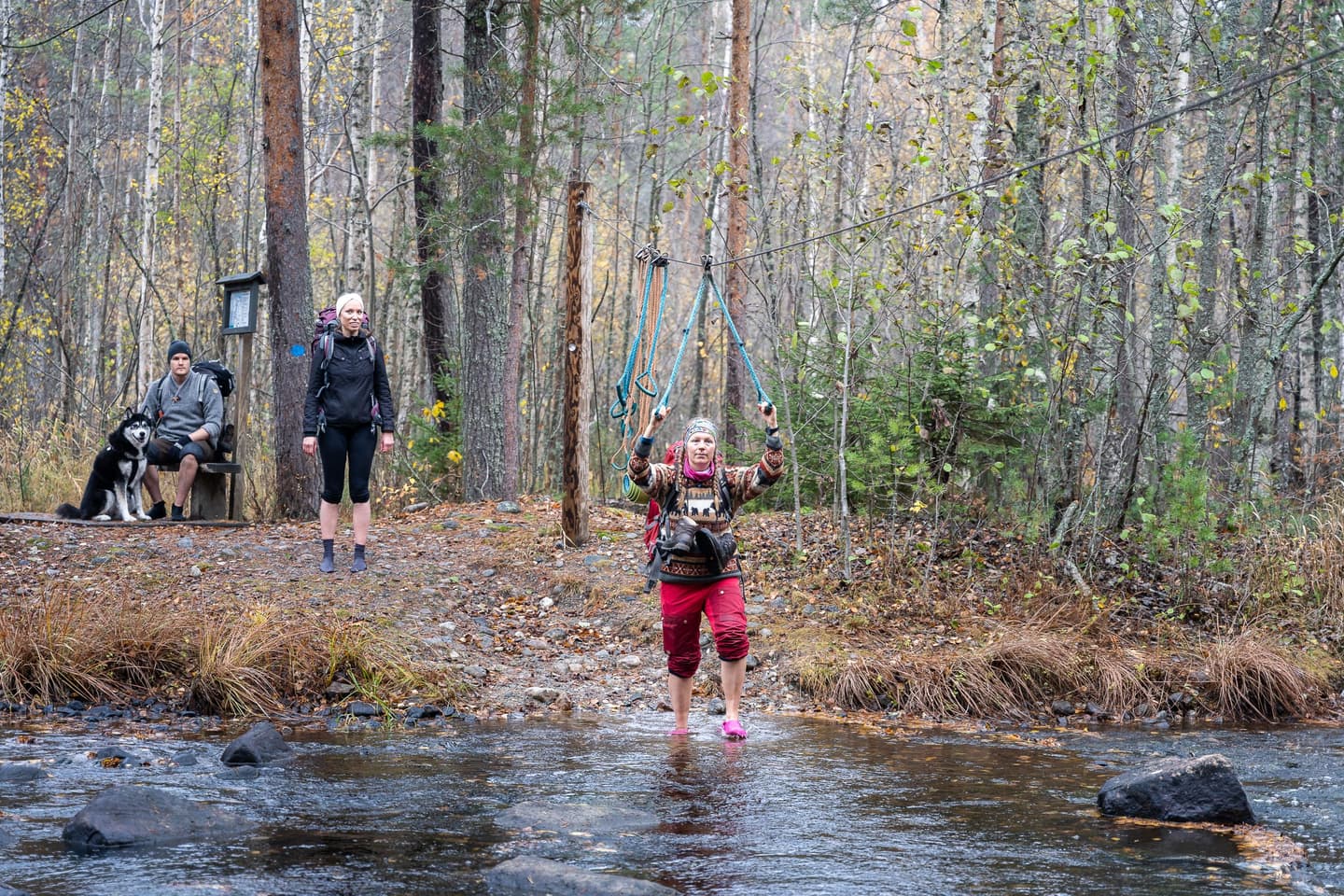
Water level
Water levels can vary greatly depending on the season and weather conditions. During spring floods, crossing a river may be impossible, while during dry periods the same crossing may be easy to make without getting your feet wet. Similarly, prolonged rainfall can cause flooding just as severe as spring floods. During extended periods of heavy rain, it is advisable to cross watercourses before water levels rise further.
The time of day can also be important when crossing watercourses. On warm days, large snowfields or glaciers may melt, causing meltwater to flow into streams and rivers. In such conditions, early morning is usually the safest time to ford.
Depth, width and current strength
A river is safest to cross where it is widest and shallowest. In these locations, the current is usually at its weakest, making fording safer. Such places may be found, for example, where a river or stream flows into a lake.
In general, the narrower and deeper the flowing water, the more dangerous it is to cross by wading. Safer crossing points may also be found upstream, where there is less water than farther downstream. The current is strongest on the outside bends of rivers.
In the fells, snow bridges sometimes form across streams and rivers, allowing even strong currents to be crossed. However, you must first ensure that the snow bridge is strong enough to support your weight. Streams flowing through mires are often deep and wide enough that they cannot be jumped across because of the soft ground. In such cases, you may need to detour around the mire or construct a backpack raft.
Water temperature and protecting your feet
The water in streams and rivers is often extremely cold, especially when there is still snow higher up in the terrain. Cold water can quickly numb your feet, making it difficult to feel sharp stones, broken glass, or other hazards on the riverbed. For this reason, it is advisable to wear some form of footwear while wading. Suitable options include neoprene water shoes, rubber boots, camp sandals, wool socks, or waterproof overshoes.
You will usually also need to roll up your trouser legs or, in deeper water, remove your trousers altogether.
If the water is shallower than knee depth, it may be possible to cross without getting wet while wearing only hiking boots. This requires waterproof boots and gaiters. The gaiters must be securely fastened to the boots, and the crossing should be completed quickly. In deeper water, rain trousers or waterproof leg coverings secured tightly around the ankle with straps or tape may help keep you dry.
Riverbed conditions and water clarity
Riverbed conditions can vary considerably during a crossing, making wading more challenging. Sometimes the bottom is firm and even, while at other times it may be rocky and slippery. There may be loose stones, or your foot may sink into peat or mud. Slippery and uneven riverbeds increase the risk of falling.
Water flowing from glaciers often contains large amounts of fine sediment, making it cloudy. In such conditions, holes and rocks on the riverbed are difficult to see, increasing the risk of stumbling.
Equipment and techniques for crossing watercourses
Trekking poles or a rope can be useful when wading. Poles can be used to test riverbed conditions, and having one or two additional points of contact improves stability.
When crossing, always place your pole upstream, allowing the current to press it more firmly against the riverbed. Move only one foot or pole at a time. With every step, ensure you have secure footing before proceeding. A hiking companion can also provide support.
A rope may also be used when crossing a river. In a group, the most experienced member first secures a rope around a tree and crosses the current while carrying the safety rope. On the opposite bank, the rope is tied securely between trees. Never tie the rope to yourself. Flowing water exerts powerful forces, and in an emergency you must be able to release the rope immediately.
The rest of the group can then cross while holding the safety rope. They should always stay downstream of the rope to avoid becoming entangled if they fall. Once everyone has crossed, the rope is pulled back across. A rope can also provide support when crossing on a fallen tree or similar natural bridge.
When crossing a watercourse, always leave the hip belt of your backpack unfastened. This allows you to remove the pack quickly if you fall into the water.
Sometimes a stream or river is too deep to ford or jump across. In such cases, a backpack raft can be made using backpacks and a lean-to shelter tarp or tent groundsheet. Lie on your stomach while using the raft and dismount by crawling ashore. Another option is to pack your backpack into a waterproof bag and swim it across to the opposite bank.
There are many ways to cross watercourses, but mastering a few reliable techniques is usually sufficient. It is a good idea to practise water crossings regularly so that the skills remain familiar.
When crossing watercourses
- Familiarise yourself with the route in advance and prepare for possible water crossings.
- Always use good judgement and patience.
- Carefully select a safe crossing point, even if it requires a detour.
- Wear suitable footwear for wading.
- Cross diagonally upstream to better compensate for the force of the current.
- The current is less likely to affect your balance if you keep your feet in contact with the riverbed whenever possible.
- Move only one foot or pole at a time to maintain stability.
- Stay focused throughout the crossing, including the final stages.
- Do not jump from rock to rock, as this increases the risk of slipping.
- Avoid wading in flowing water deeper than knee height.