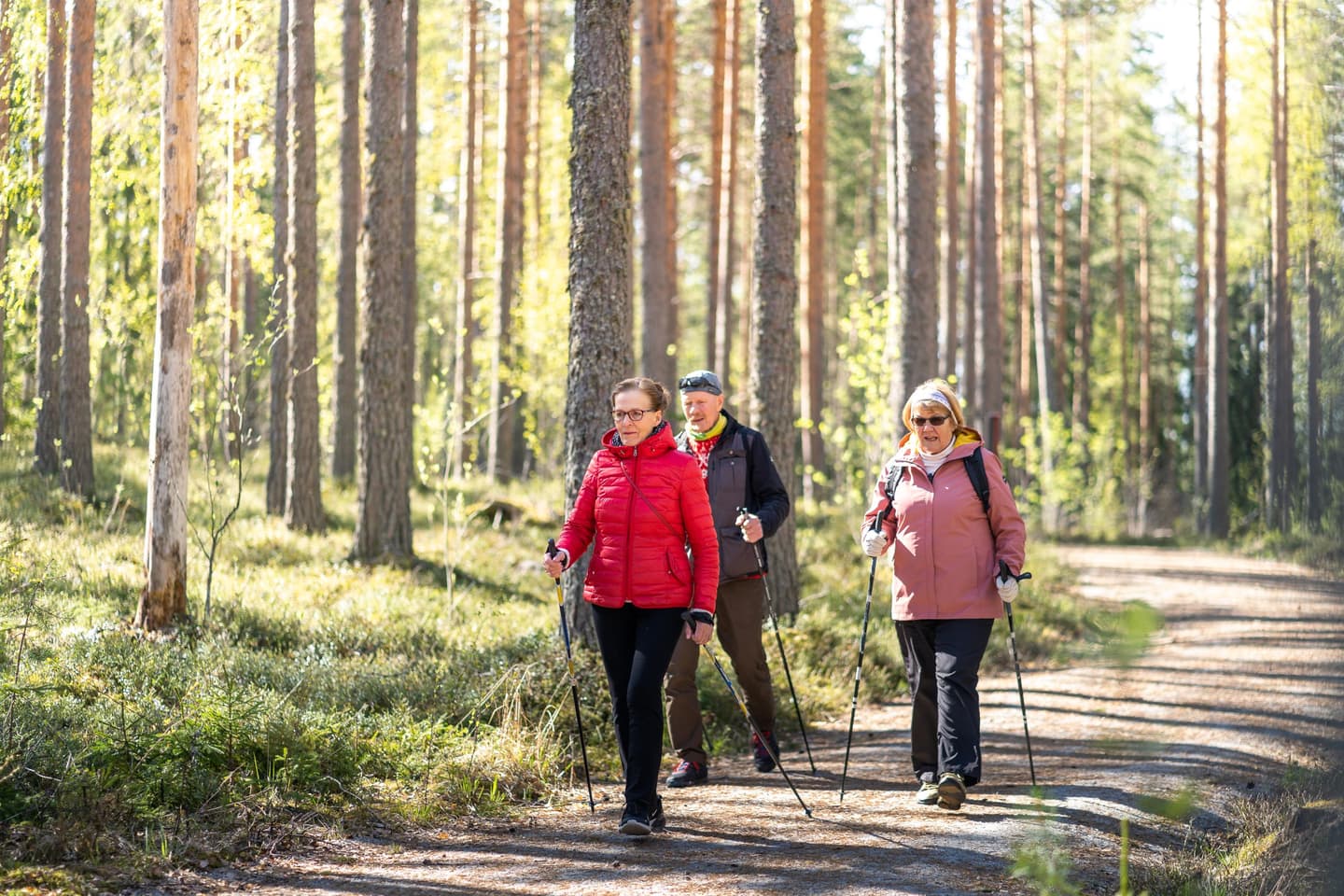
Nordic walking is a great activity because it’s suitable for any type of terrain and people of all ages. The intensity of the activity can be adjusted, allowing both beginners and competitive athletes to effectively use the poles in their training. The poles help maintain balance in challenging terrain and, on the other hand, encourage people to climb slopes even more vigorously. The poles provide additional momentum and rhythm when walking on level ground. You should also take a set of poles on a wilderness hike.
Walking with poles is more effective than without them. However, walking with poles is often perceived as being less intense than ordinary walking. Nordic walking raises your heart rate more than walking. All the body muscles are working, which increases oxygen and energy consumption in comparison to regular walking. It’s important to remember that intensity is always influenced by a person’s technique, pace and fitness level as well as the walking terrain. Learning the right technique is important in order to get the most out of your poles.
Equipment
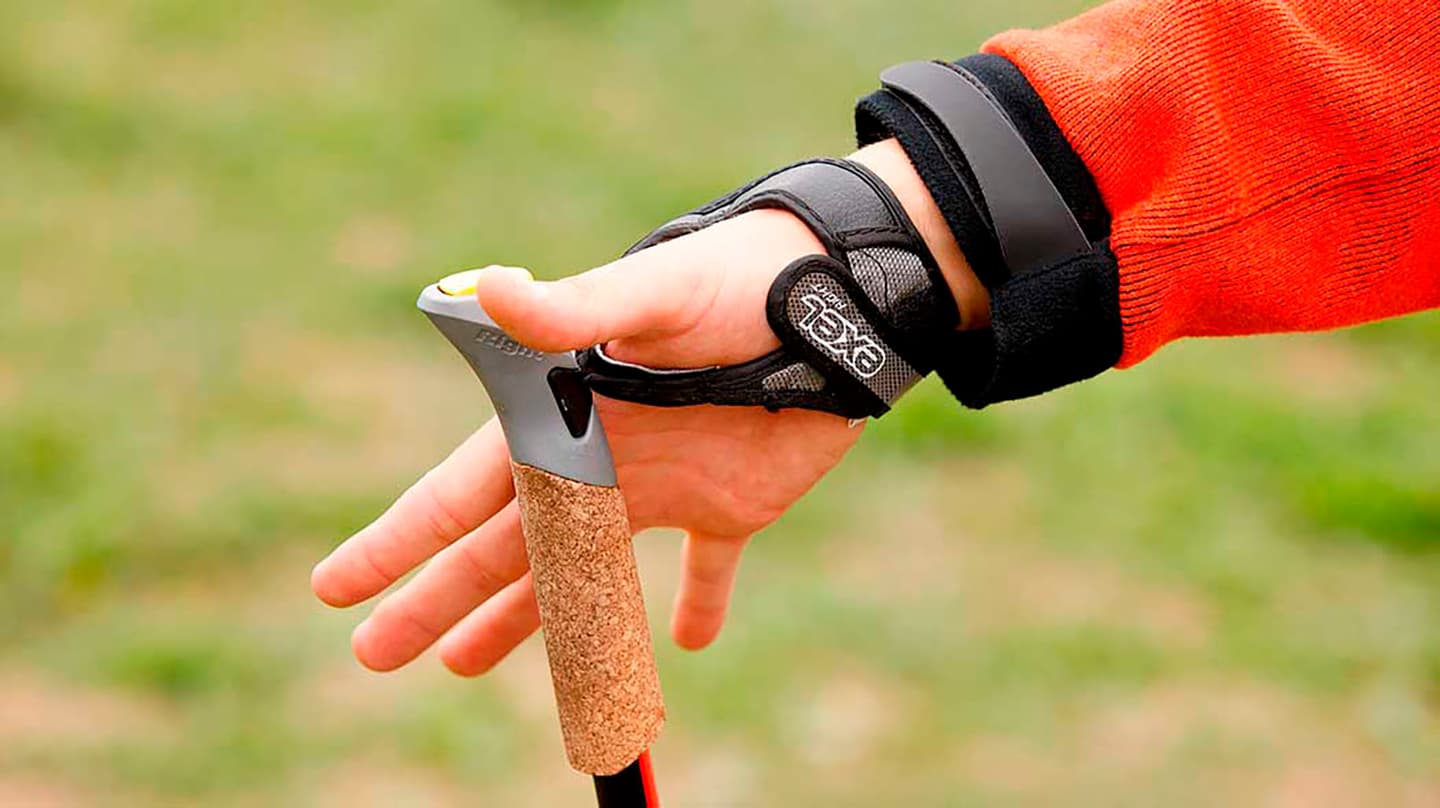
A suitable pole length is 0.68 times your own height. In borderline cases, beginners should preferably choose shorter and an experienced walker slightly longer poles. You can also find a suitable pole length by trying different poles. Keep your lower arm close to your side and flex your elbow at a 90-degree angle to keep a relaxed grip on the pole. A good hand strap will keep the right type of pole in your hand even when you’re not holding onto it.
A good Nordic walking pole strap:
- is durable and provides support,
- fits your hand well,
- is soft and does not have any abrasive parts or seams that interfere with blood circulation, and
- is adjustable and removable.
Continuously squeezing the handle of the pole can cause tension in the shoulders and even raise your blood pressure. This means that when your hand is behind the body line, the outer edge of your palm should rest against the hand strap while your fingers release the handle.
The tip is an important feature of the pole. A properly-shaped tip strikes the ground at the right angle and does not slip. Light metal tips should be used when walking on soft terrain or on snow and ice in the winter. On harder surfaces, you need an asphalt pad to reduce vibration and noise. The pad is shaped to provide good traction throughout the pole’s range of motion.
Depending on the material and quality, Nordic walking poles cost between EUR 20–100 and they are very durable. Adjustable telescopic poles are convenient to carry with you, but their shock absorption and stability are slightly less than ordinary poles.
The characteristics of good Nordic walking footwear are:
- a heel cup that provides support,
- a flexible sole under the ball of the foot,
- rotational stiffness in the middle section, and
- shock absorption under the heel.
On level terrain, Nordic walking can also be combined with dog walking or pushing a pram. You can attach a belt to your waist to which you clip the dog’s leash or use a strap attached to the pram. Pull the pram behind you. If the pram model permits, lower the pram as if you were putting it into a car so that the pram remains stable and upright. If the pram can’t be lowered, you can tie the strap to the bottom of the pram to ensure a smooth and safe journey. Remember that Nordic walking with a dog or a pram requires alertness because your hands are holding onto the poles.
Nordic walking at different fitness levels
Are you a casual walker who doesn't want to sweat while being active? Are you an active person who uses Nordic walking to improve your endurance and strength, for example, by climbing hills? Your goal also affects your equipment selection.
- A beginner walks on a level surface and should be able to talk while walking without getting out of breath. The length of your poles should be 0.62 times your own height.
- An active person also walks briskly on gentle slopes, and sometimes gets out of breath. The length of your poles should be 0.65 times your own height.
- A person with a good fitness level exercises and sweats systematically towards their goal. The length of your poles should be 0.68 times your own height.
- An athlete runs up demanding slopes, walks longer distances and may even include anaerobic interval sessions. The length of your poles should be 0.72 times your own height.